Stop Automating the Wrong Things
Most automation projects fail not because the tools are bad, but because teams automate broken processes. Here's the framework that actually sticks.
March 15, 20256 min read
Read article →Every few weeks another headline shows up promising that AI is coming for someone's job. The reaction is almost always the same: a mix of dread and paralysis. Some people freeze. Some people write it off as hype. Both reactions miss what's actually happening.
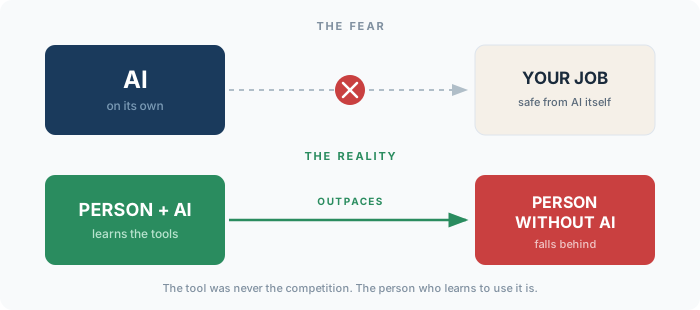
AI isn't replacing jobs on its own. It's raising the bar on what one person can get done in a day — and the people who learn to use it are the ones pulling ahead of everyone who's still doing things the old way. That's not a talking point. It's the same dynamic that's played out with every major shift in business tools, and it's playing out again right now, just faster.
Think about what actually happens when a solo founder or small business owner adopts AI well. The person who used to spend three hours drafting a proposal now does it in twenty minutes and spends the rest of that time on client calls. The person who used to manually sort through fifty leads a week now has a system that qualifies them automatically and only surfaces the ones worth a real conversation.
Multiply that across a week, and one person is now doing work that used to take a small team. That's the actual shift. It's not "AI does the job instead of a person." It's "a person using AI well does the job of several people who aren't."
If your competitor's team is moving faster than yours, closing deals faster, answering client questions faster — it's rarely because they have better people. It's because their people aren't doing the repetitive work by hand anymore, and yours still are.
Having ChatGPT open in a browser tab isn't what separates the businesses pulling ahead from the ones standing still. That's dabbling, not using. The founders actually getting hours back every week are doing something more deliberate: they're identifying the repetitive, predictable parts of their business and building systems around them — lead follow-up, proposal generation, reporting, client onboarding, invoice tracking.
The distinction matters because it changes what "learning AI" actually requires. It's not about becoming a prompt engineer or a developer. It's about being able to look at a process in your business and ask a specific question: does this step require human judgment, or is it just eating time that could run automatically? That's a skill anyone can build, regardless of technical background.
Here's what most people get wrong about this moment: the scarce skill isn't knowing how to use a specific AI tool. Tools change constantly, and today's favorite will be replaced by something else in eighteen months. The scarce skill is process thinking — the ability to break down how work actually gets done, spot where it's wasting time, and know what's worth automating versus what still needs a human.
That's judgment, not software literacy. It's the same skill a good operations person has always needed. AI just made the payoff for having it much bigger, because the tools to act on that judgment are now available to anyone, not just companies with a dev team and a six-figure software budget. It's the same judgment behind the Audit → Optimize → Automate framework — knowing what to fix before you automate it is the whole skill.
Large companies have had automation for years — expensive, custom-built systems with dedicated teams to maintain them. What's changed is that solo founders and small business owners now have access to the same leverage without the enterprise price tag. That's a real advantage, but only for the ones who use it.
The founders wearing five hats — sales, delivery, admin, marketing, and support all at once — are exactly the people who benefit most from offloading the repetitive parts of that list. The ones who do it free up hours to focus on the parts of the business that actually need a human: relationships, strategy, the work only they can do. The ones who don't stay buried in admin work while their competitors move faster with the same number of hours in the day.
You don't need to rebuild your business around AI overnight. Start with one honest question: what repetitive task ate the most of your time last week? Not the task you think you should automate — the one that actually consumed your hours. Client follow-up? Reporting? Scheduling back-and-forth? Data entry between tools that don't talk to each other?
Pick that one thing. Map out exactly how it works today, step by step. Then ask which parts of it genuinely require your judgment and which parts are just repetition. Automate the repetition first. That single change is usually enough to reclaim several hours a week — and it builds the process-thinking skill that makes the next automation easier to spot. If you want a structured walkthrough of that first build, our AI Automation Starter Guide covers it step by step, no coding required.
AI was never going to replace your job by itself. It's a tool, not a competitor. But the person down the street, or the founder in your same market, who learns to use that tool well is absolutely capable of outpacing a business that doesn't. That's not a threat to be anxious about — it's a straightforward incentive to get ahead of it.
The businesses that get hours back every week aren't the ones with the fanciest AI stack. They're the ones who took an honest look at where their time was going and built systems around the parts that didn't need a human. That's a decision you can make this week, not a technology problem to solve someday.
If you're not sure where to start, that's exactly what a free discovery call is for — we'll map your biggest time drains and tell you honestly what's automatable in your business. No pitch, just clarity.
Get your free time audit—we'll map exactly where your team is losing hours.
Get free time audit →Most automation projects fail not because the tools are bad, but because teams automate broken processes. Here's the framework that actually sticks.
A 10-person agency was losing 47 hours a week to manual work they didn't even know was automatable. Here's what we found—and fixed.
There are 5 predictable reasons automation projects fail. Most teams hit all 5. Here's how to avoid every one of them.