Stop Automating the Wrong Things
Most automation projects fail not because the tools are bad, but because teams automate broken processes. Here's the framework that actually sticks.
March 15, 20256 min read
Read article →This is a real time audit, start to finish—what we found, in whose words, and exactly how it got fixed. For the general framework behind this process, see Audit → Optimize → Automate.
When we started working with a 10-person digital marketing agency, their leadership team believed they had a capacity problem. They were turning down new clients not because of lack of demand, but because the team simply didn't have bandwidth. They assumed the solution was hiring.
After a two-week time audit, we found something different: the team was collectively losing 47 hours per week to manual, repetitive work that they had never seriously questioned. That's more than one full-time employee worth of capacity—sitting invisible inside existing workflows.
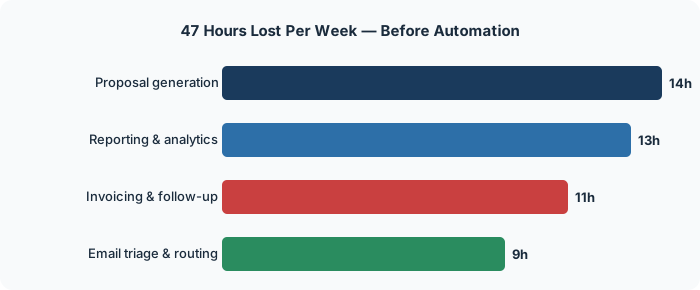
Email sorting and triage: 9 hours/week. Each account manager was manually reading, categorizing, and forwarding client emails to the right team members. There was no shared inbox system, no tagging convention, and no routing logic. Client requests routinely sat for hours before reaching the person who needed to act on them.
Proposal generation: 14 hours/week. Every new proposal was built from scratch in a Google Doc. Team members would pull figures from three different spreadsheets, copy in service descriptions from a folder of old proposals, and manually format everything before review. Proposals for similar service packages looked completely different from each other because there was no template or system.
Invoicing and payment follow-up: 11 hours/week. Invoices were created manually in a spreadsheet, exported to PDF, and emailed individually. Late payments were tracked in a separate sheet, and follow-up emails were written one at a time, from memory, whenever someone remembered to check.
Reporting compilation: 13 hours/week. Monthly client reports pulled data from five different platforms—Google Analytics, Meta Ads, Google Ads, a CRM, and a rank tracker. Someone spent roughly three hours per client per month copying numbers into a branded slide deck.
Email triage moved to a shared inbox with automated routing rules. Emails from known client domains were tagged and assigned automatically. The team reclaimed 7 of the 9 hours—the remaining two involved genuinely ambiguous messages that still needed human judgment.
Proposals became template-driven. A standardized proposal builder pulled pre-approved service descriptions, pricing logic, and client-specific details from a CRM into a consistent format. What took 90 minutes per proposal now takes 20.
Invoicing moved to an automated billing system. Recurring invoices generate and send themselves. Late payment sequences trigger automatically at 7, 14, and 21 days overdue. The team went from 11 hours of invoicing work per week to under 2.
Reporting was connected via API integrations that pulled all platform data into a single dashboard. The slide deck population was partially automated, reducing three hours per client to 45 minutes.
Six weeks after implementation, the agency had effectively added the equivalent of a full-time employee's worth of capacity without a single new hire. They onboarded two new clients in the first month using reclaimed time—clients they would previously have turned away.
The most common reaction from teams after a time audit like this is disbelief: "We didn't realize we were doing that." Manual processes don't announce themselves. They just quietly compound, hour by hour, until they become the ceiling on your growth.
Want to run this on your own team? Our 5-day time audit guide walks through the exact process we used here.
Get your free time audit—we'll map exactly where your team is losing hours.
Get free time audit →Most automation projects fail not because the tools are bad, but because teams automate broken processes. Here's the framework that actually sticks.
There are 5 predictable reasons automation projects fail. Most teams hit all 5. Here's how to avoid every one of them.
Real estate teams spend 60% of their time on follow-up, scheduling, and admin. Here's the exact automation stack that reclaims it.