The Hidden Cost of Manual Processes
A 10-person agency was losing 47 hours a week to manual work they didn't even know was automatable. Here's what we found—and fixed.
March 28, 20258 min read
Read article →This is the framework we use to decide what to automate and in what order—the full playbook behind the approach. If you want to see it applied to a real business first, the agency case study walks through exactly this process end to end. If you've already run an automation project and it didn't stick, the five reasons projects fail is a faster way to diagnose what went wrong. And if you're wondering whether any of this still matters with AI in the picture, it does—see why the framework, not the tool, is still the whole skill.
Here's a scenario that plays out in businesses every week: a team decides they're going to "get serious about automation." They buy a tool, spend three weeks setting up workflows, and then quietly abandon it six months later because it never delivered the time savings they expected. Sound familiar?
The problem almost never comes down to the tool. The problem is that they automated a broken process—and now they have a fast broken process.
Most teams jump straight from "we have a problem" to "let's automate it." That instinct is understandable—automation tools are more accessible than ever, and the promise of saving hours is compelling. But skipping two critical steps upstream is exactly why most projects underdeliver.
Consider a real example: a marketing agency was spending 12 hours a week on client reporting. Their instinct was to automate the report generation. Before doing anything else, an audit revealed that half the data being included in those reports was never read by clients. They were generating detailed analytics for metrics clients didn't care about. Optimizing first—stripping the report down to what clients actually needed—cut the time to 4 hours before a single automation was built. The automation then brought it to under 30 minutes.
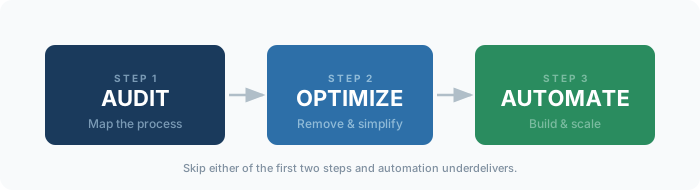
Step 1: Audit. Map every touchpoint of the process you want to automate. Who does what, in what order, and how long does each step take? You're looking for two things: steps that are redundant, and steps that exist only because of a previous inefficiency. A good audit exposes the true shape of the process—often very different from what people assume it looks like.
Step 2: Optimize. Before a single automation tool is opened, redesign the process. Remove steps that don't add value. Standardize inputs so they're consistent. Eliminate approval layers that exist out of habit rather than necessity. A rule of thumb: if you can't explain why a step exists in one sentence, it probably shouldn't exist at all.
Step 3: Automate. Only now do you introduce tools. With a clean, optimized process, automation is fast to build and reliable to maintain. You're connecting well-defined inputs to well-defined outputs—not trying to automate ambiguity.
An e-commerce team was manually updating inventory spreadsheets from three different supplier feeds every morning—a two-hour daily ritual. An audit revealed that one supplier feed was rarely different from the previous day, and another updated only weekly. Optimizing first meant they only needed to check one live feed daily. Automation then handled that single connection automatically. Total time saved: two hours daily, with an automation that took less than a day to build.
The framework works because it forces honest questions before you spend time and money on tooling. The audit creates clarity. Optimization creates leverage. Automation creates scale. Skip the first two steps and you're just adding machinery to a mess.
Before your next automation project, ask yourself: have we audited this process honestly? Have we optimized it as much as possible without any tools? If the answer to either is no, start there. The automation will be faster to build, more reliable to run, and far more likely to deliver the results you're actually after.
Get your free time audit—we'll map exactly where your team is losing hours.
Get free time audit →A 10-person agency was losing 47 hours a week to manual work they didn't even know was automatable. Here's what we found—and fixed.
There are 5 predictable reasons automation projects fail. Most teams hit all 5. Here's how to avoid every one of them.
Real estate teams spend 60% of their time on follow-up, scheduling, and admin. Here's the exact automation stack that reclaims it.