Stop Automating the Wrong Things
Most automation projects fail not because the tools are bad, but because teams automate broken processes. Here's the framework that actually sticks.
March 15, 20256 min read
Read article →Most service businesses have a lead funnel that works something like this: a potential client fills out a form, someone at the company notices it, manually sends an email, hopes they respond, eventually gets on a call, sends a proposal, follows up a few times, and either closes or loses the deal. The entire process is held together by human memory and manual effort.
What if none of those handoffs required a human to initiate them? What if the system did the work, and you showed up only for the conversations that actually required your expertise?
That's what a fully automated client funnel looks like. Here's how to build one.
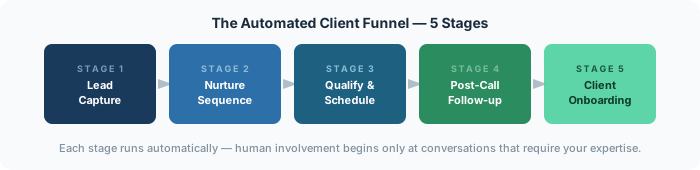
Every lead source—website forms, landing pages, social media ads, referral links, event registrations—should flow into a single CRM automatically. No manual import of spreadsheets, no copying from email into a contact database. The connection between lead capture and CRM entry should be seamless and immediate.
When a lead enters the CRM, the system should automatically tag them based on how they arrived (organic search, paid ad, referral), what they inquired about, and any qualifying information they provided in the form. These tags drive everything downstream, so getting the initial categorization right matters.
The first message a lead receives should arrive within minutes of submitting their information—not when someone checks their email. An automated nurture sequence serves two purposes: it keeps your business top of mind, and it qualifies the lead before any human time is invested.
A strong nurture sequence for a service business typically runs 5–7 touchpoints over 10–14 days. The first message acknowledges their inquiry and sets expectations. Subsequent messages share relevant content—case studies, guides, or frameworks that demonstrate expertise. A mid-sequence message asks a qualifying question ("What's your biggest challenge right now with X?"). The final messages in the sequence are gentle, direct offers to book a call.
Responses to any message in the sequence should trigger a branch in the automation. A reply means human follow-up. A calendar booking means they've self-qualified. No response after the full sequence means they move to a long-term nurture cadence rather than active follow-up.
Leads who want to move forward should be able to self-schedule without a back-and-forth email chain. A scheduling tool connected to your calendar lets them pick a time that works, answer a few pre-call questions, and receive an automated confirmation with a video call link—all without your involvement.
Pre-call questions are underused but valuable. Asking about budget range, timeline, team size, or current challenges gives you context before the call starts. You arrive prepared instead of spending the first 10 minutes on discovery basics. The answers also flow back into the CRM, updating the contact record automatically.
After a discovery or sales call, most service businesses drop the ball on speed. Proposals take days to produce; follow-up is an afterthought. Automation can't write the proposal for you, but it can trigger the right follow-up actions immediately.
A post-call automation sends a thank-you message, sets a task reminder for your team to send the proposal within a defined window, and begins a follow-up sequence if the proposal isn't opened within 48 hours. Proposal tools with open tracking can trigger automatic check-in messages based on engagement—someone who opened the proposal three times is a very different follow-up target than someone who hasn't opened it at all.
When a deal closes, onboarding should begin automatically. A welcome sequence delivers contracts, intake forms, and introductory resources in a structured sequence. Completion of each step—signing the contract, returning the intake form, scheduling the kickoff call—triggers the next. New clients feel taken care of, and your team doesn't have to manually chase paperwork.
You don't need expensive enterprise software to build this. The stack has four layers: a CRM (to store and manage contacts), an email automation platform (to run sequences), a scheduling tool (to let leads self-book), and a workflow connector (to tie everything together when native integrations don't exist). There are reliable, affordable options in each category for businesses at every stage.
Start with the CRM and get lead capture flowing in automatically. Add the nurture sequence next. Then layer in scheduling. Each stage delivers value on its own—you don't have to build the entire funnel before you start seeing results. But once all five stages are running together, the combined effect is a client acquisition system that works around the clock without your constant attention.
Ready to build stage one? Our hands-on Zapier walkthrough builds the exact lead capture → CRM → follow-up sequence this starts with, no coding required.
Get your free time audit—we'll map exactly where your team is losing hours.
Get free time audit →Most automation projects fail not because the tools are bad, but because teams automate broken processes. Here's the framework that actually sticks.
A 10-person agency was losing 47 hours a week to manual work they didn't even know was automatable. Here's what we found—and fixed.
There are 5 predictable reasons automation projects fail. Most teams hit all 5. Here's how to avoid every one of them.