Stop Automating the Wrong Things
Most automation projects fail not because the tools are bad, but because teams automate broken processes. Here's the framework that actually sticks.
March 15, 20256 min read
Read article →Real estate is one of the most relationship-driven industries in existence—which makes it ironic that so much of an agent's week is consumed by work that has nothing to do with relationships. Follow-up emails, showing coordination, document management, CRM updates: these tasks are necessary but not differentiating. They're also exactly where automation delivers the fastest returns.
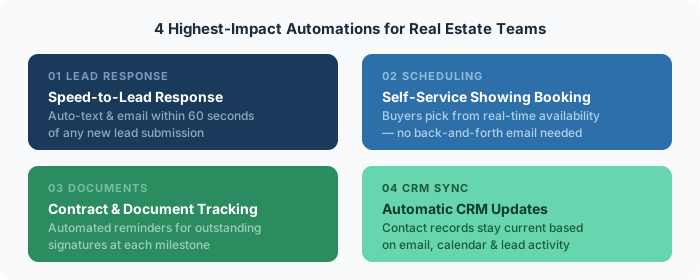
Here's a breakdown of the four highest-impact automation opportunities for real estate teams—and how to approach each one without writing a line of code.
A Harvard Business Review analysis of 1.25 million sales leads across 42 companies found that firms contacting a lead within an hour were nearly seven times as likely to qualify it — defined as a meaningful conversation with a key decision-maker — as those who waited even a little longer, and more than 60 times as likely as those who waited a day. Yet most agents are following up with new leads hours later, after they've finished a showing or wrapped up a client call.
Automating the first touchpoint changes this completely. When a new lead submits a form—from your website, Zillow, Realtor.com, or any other source—an automated sequence can send a personalized text and email within seconds, ask qualifying questions, and book a consultation call, all before you've had a chance to manually respond. The agent's involvement begins when the lead is already warmed up and scheduled.
The key is building a follow-up sequence that sounds human, not robotic. Personalization tokens (first name, the property they inquired about, their timeline) go a long way. A five-touch sequence over 10 days covers the leads who don't respond to the first message without requiring manual effort.
Coordinating showing schedules is a tedious multi-party coordination problem. A buyer wants to see three properties. Each has a different listing agent with different availability windows. Getting everyone aligned via phone and email can take an hour of back-and-forth for what is ultimately a logistics problem.
Scheduling automation tools let buyers self-select from available windows that sync with your calendar in real time. Confirmations and reminders go out automatically. Rescheduling requests can often be handled without agent involvement. Teams that implement showing automation consistently report saving 6–8 hours per week on scheduling alone.
Real estate transactions generate an enormous amount of paperwork. Tracking which documents have been signed, which are outstanding, and who needs to take action next is a full-time job during a busy closing period.
Document workflow automation creates a checklist-driven process where every required document has a responsible party, a due date, and an automated reminder if it's not completed on time. Status updates go to clients automatically. Nothing falls through the cracks because the system tracks it, not a person.
A CRM is only as useful as the data inside it—and most real estate CRMs have data that's six months out of date because updating contact records manually is the first thing that falls off when agents get busy.
Connecting your lead sources, email platform, and calendar to your CRM means contact records update automatically based on activity. When a lead opens an email, replies, books a showing, or moves to a different stage in the pipeline, the CRM reflects it without anyone touching it. Agents spend their time on relationships, not data entry.
The most common mistake real estate teams make is trying to automate everything at once. Start with lead follow-up—it's the highest-leverage area and delivers visible results quickly. Once that's running reliably, add showing scheduling. Then document management and CRM automation. Built sequentially, each layer compounds on the last, and the cumulative time savings reach the 8+ hours per week that most teams are leaving on the table today.
For the full stack and specific tool recommendations across real estate, marketing, and professional services, see our industry automation playbooks. If you run a trades or field-service business rather than a brokerage, the same thinking applied to that world is in AI Automation for Home Services Businesses.
Get your free time audit—we'll map exactly where your team is losing hours.
Get free time audit →Most automation projects fail not because the tools are bad, but because teams automate broken processes. Here's the framework that actually sticks.
A 10-person agency was losing 47 hours a week to manual work they didn't even know was automatable. Here's what we found—and fixed.
There are 5 predictable reasons automation projects fail. Most teams hit all 5. Here's how to avoid every one of them.