Stop Automating the Wrong Things
Most automation projects fail not because the tools are bad, but because teams automate broken processes. Here's the framework that actually sticks.
March 15, 20256 min read
Read article →When we started working with a small accounting and tax practice in Delaware, their website had been down for a while. They weren't even sure which of several old GoDaddy accounts owned the domain. Anyone looking for them online came up empty.
Getting the site back up was the obvious fix. But it also made us think about how people look for a business now. Some still type a search into Google and click a link. Some read the box at the top of the results and never scroll. And more and more people skip Google and just ask ChatGPT. That's where the three acronyms come in.
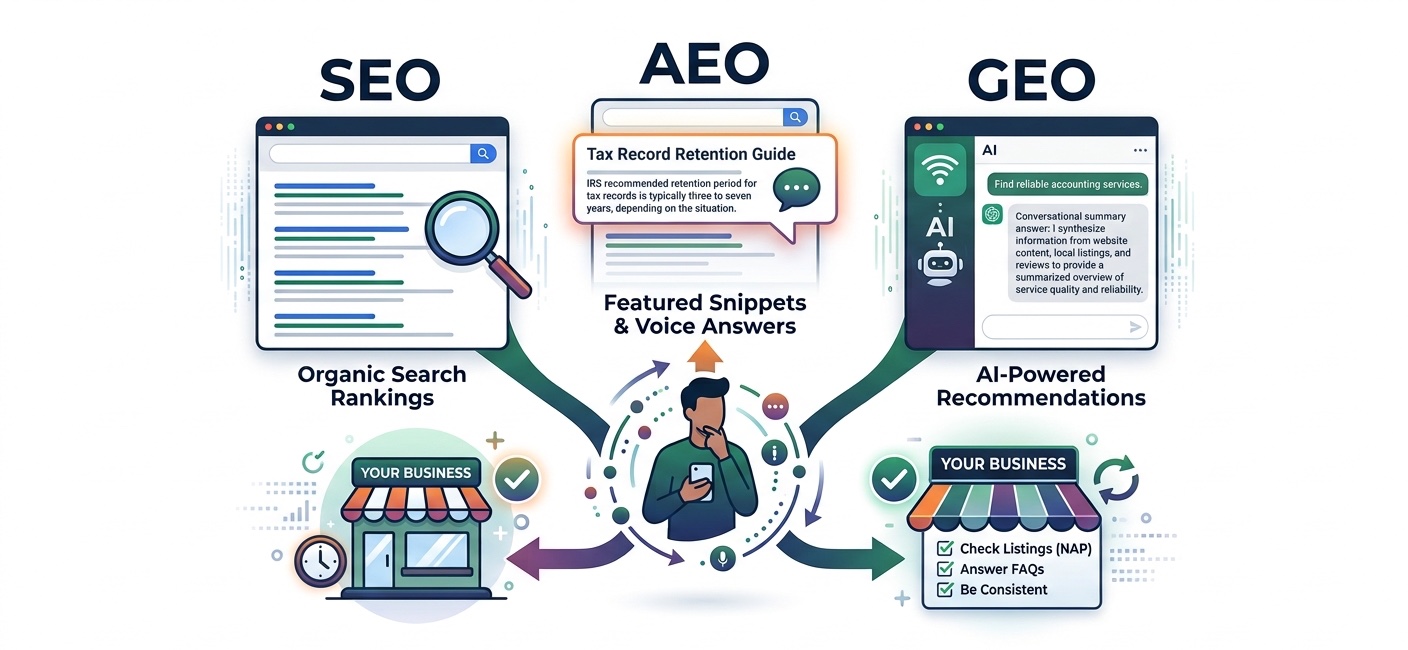
Search engine optimization means ranking in Google's regular list of results. Page speed matters, so does how the site works on a phone, whether the pages are built cleanly, and whether other websites link to yours. If search engines can't read your site properly, nothing else in this post will help much, so this comes first.
Answer engine optimization is about the answer box. You've seen it: you search "how long should I keep tax records" and Google shows a short answer pulled from someone's website, above all the links. Voice assistants do the same thing out loud.
Google tends to pick pages that ask the question in a heading and answer it in the next sentence or two, without a long lead-in. It's the reason many of our posts end with an FAQ section.
Generative engine optimization is the newest of the three, and the one most small businesses haven't looked at yet. When someone asks ChatGPT, Perplexity, Gemini, or Copilot for a recommendation, the tool draws on what it has read about businesses online. Sometimes it links to you. More often it just mentions you by name, or leaves you out.
Consistency matters more than most people expect. If your website says you close at 6 and your Google Business Profile says 5, or your LinkedIn still lists a service you dropped two years ago, these tools get less sure about you. It also helps when other websites mention you: local directories, partners, clients who link to you. And plain writing works better than marketing copy. "We do bookkeeping for restaurants in Austin" is much easier for an AI tool to repeat than "empowering your financial journey."
Most of the work overlaps. A site that loads fast, answers real questions in plain words, and keeps its details consistent tends to do well with Google, with answer boxes, and with AI tools. You'll also see other acronyms like LLMO and AIO. For a small business, we'd ignore them. They mostly describe the same things under a different name.
Back to the Delaware firm. The new site was only part of the fix. Before, the people who did find them called, texted, or emailed, and none of it ended up in one place. So we connected the site's contact form to a dashboard. Every inquiry now lands in one list with its status, and the owner gets an email as soon as a new one arrives. We also added a booking calendar, so someone who's ready can schedule a meeting with the owner right there instead of waiting for a callback. (The full case study is here.)
We bring this up because it's easy to spend months on visibility and then let new inquiries sit in an inbox until Thursday. If you're working on one, look at the other too. Our post on what to automate from day one starts with exactly that.
Start by searching for yourself. Ask ChatGPT, Perplexity, and Gemini the kind of question a customer would ask, and see who comes up. Then check that your name, address, phone number, hours, and services match on your website, Google Business Profile, LinkedIn, and any directories you're listed in. That part is tedious, but it's free.
After that, pick the page on your site that matters most, usually the homepage or your main service page. Make sure it answers the questions customers actually ask you on the phone. If you've got a few of those written down already, add them as a short FAQ at the bottom.
If you'd like help making sure every inquiry gets a fast reply once people do find you, book a free 30-minute call. No pitch, just a clear map of what's automatable in your business.
SEO gets your site ranked in Google's list of links. AEO gets your content shown as the direct answer, like a featured snippet or a voice-assistant reply. GEO gets your business mentioned when someone asks an AI tool like ChatGPT or Perplexity. Most of the work overlaps, so one well-built site can do all three.
Not quite. SEO is about ranking in a list of links that people click. GEO is about being a source an AI tool trusts enough to mention in its answer, often without any link. The basics overlap, but AI tools lean more on plain, factual writing and on what other sites say about you.
Ask them. Type a question a customer would ask into ChatGPT, Perplexity, and Gemini, and see which businesses get named. If competitors show up and you don't, that's your starting point. Check again every few months, since AI answers change as the tools update.
There's no guaranteed timeline. Search rankings usually move over months, not days. AI answers can sometimes change faster as the tools re-read the web, but that isn't predictable either. Steady improvements to your site and listings add up over time, and there's no shortcut that skips the wait.
Not to start. Fixing your listings, rewriting one key page, and adding an FAQ are things you can do yourself in an afternoon. Help makes sense when you need a new website, structured data, or a contact form connected to follow-up that runs automatically.
Get your free time audit—we'll map exactly where your team is losing hours.
Get free time audit →Most automation projects fail not because the tools are bad, but because teams automate broken processes. Here's the framework that actually sticks.
A 10-person agency was losing 47 hours a week to manual work they didn't even know was automatable. Here's what we found—and fixed.
There are 5 predictable reasons automation projects fail. Most teams hit all 5. Here's how to avoid every one of them.